Published August 2026 · ProSponsor Research
I was watching the Tour Championship at East Lake this weekend when the broadcast mentioned something about Tommy Fleetwood that surprised me: he still doesn't have an apparel sponsor.
The announcer said Fleetwood will sometimes wear a shirt or hat from the pro shop at the course he is playing.
That caught my attention because we're not talking about a player trying to establish himself on the PGA Tour.
Fleetwood arrived at East Lake as the defending Tour Championship winner. A year earlier, he won the event at 18-under, three shots ahead of Russell Henley and Patrick Cantlay. It was his first PGA Tour victory, coming in his 164th career start.
He also won the FedEx Cup and collected $10 million.
This year, Scottie Scheffler won the $40 million Tour Championship at 16-under, three shots ahead of Viktor Hovland. Fleetwood was back at East Lake trying to defend his title.
Yet one year after the biggest PGA Tour win of his career, Fleetwood still has no full apparel deal.
That is unusual enough to make him, in my view, one of the most under-endorsed top players in golf.
Fleetwood already had the résumé
Fleetwood's 2025 win mattered in part because of how long he had come close without getting one.
Before winning the Tour Championship, he had recorded 30 top-five finishes without a victory, the most in PGA Tour history.
He had also earned $33.4 million before his first PGA Tour win, the most career earnings by a player who had not yet won on Tour.
Then he won one of the biggest events on the schedule.
So Fleetwood's current endorsement situation is not a question of whether he has done enough on the course to attract brands.
The more interesting explanation is that he appears comfortable being selective about what he signs.
Fleetwood and Nike separated at the start of the 2026 season after a relationship that had lasted more than 10 years.
Instead of immediately signing with another apparel company, Fleetwood began the season wearing his own mix of clothing.
And for most of 2026, that remained the arrangement.
Then Blackstone took the hat
A week before the 2026 Masters, Fleetwood signed with investment firm Blackstone, becoming the company's first global brand ambassador.
Blackstone took the prominent hat position without becoming Fleetwood's apparel provider.
That distinction matters.
Fleetwood described the arrangement this way:
"I'm wearing a Blackstone hat, but I still have all the freedom of wearing my own clothes."
That tells us quite a bit about what he values in his current setup.
He is willing to sign brand partnerships. He just hasn't signed another traditional apparel agreement that dictates what he wears from head to toe.
Blackstone was able to establish a major presence without asking him to give that up.
From a brand perspective, that is where Fleetwood becomes especially interesting.
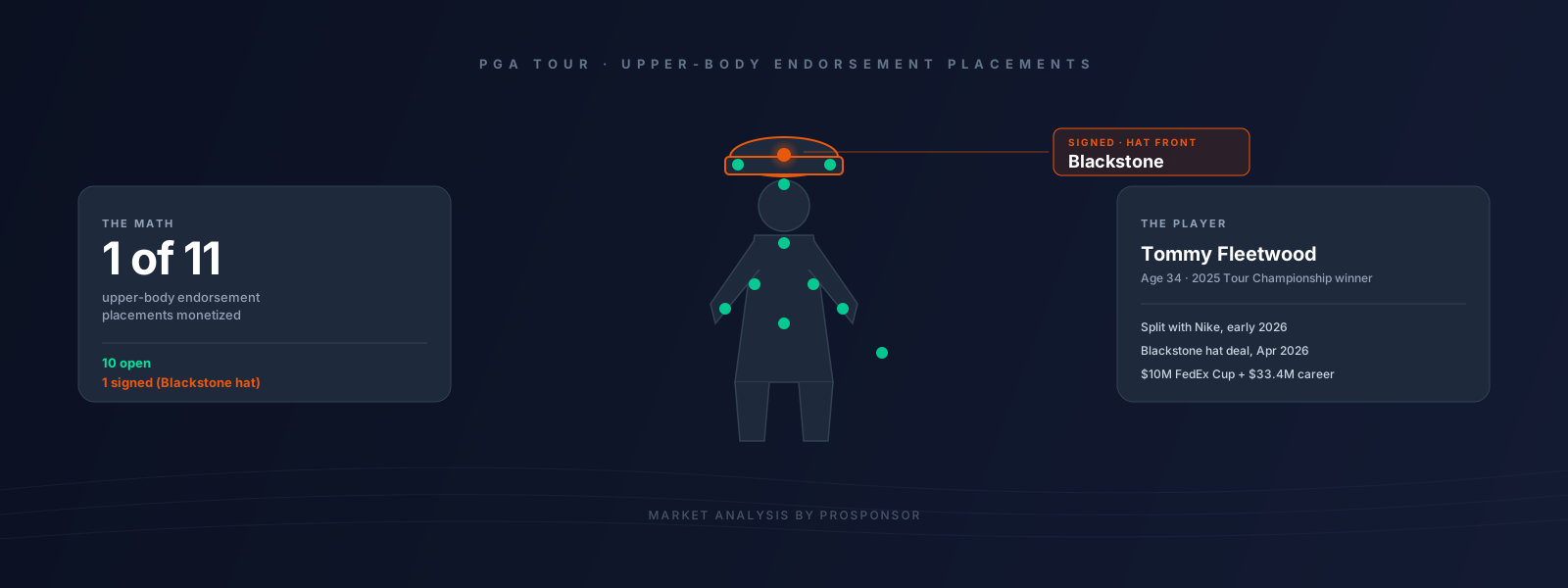
One prominent placement is signed. Many others are not.
A PGA Tour player can carry roughly 11 distinct upper-body endorsement placements, including seven shirt positions and four headwear positions.
Fleetwood is using the most prominent hat position for Blackstone.
Beyond that, his appearance remains unusually clean for a player at this level.
There is an important qualification here: open placement does not necessarily mean Fleetwood is trying to sell it.
His decision to remain outside a full apparel agreement appears deliberate. Any brand approaching him would have to take that into account.
But brands should not confuse not wanting a traditional apparel deal with not wanting additional brand partners.
Blackstone already demonstrated the difference.
Fleetwood kept control over his clothing while Blackstone secured one of the most visible positions a golfer can offer.
There is no reason another non-apparel category could not consider a similar approach.
The opportunity may be outside apparel
The first instinct when looking at Fleetwood might be to ask which apparel company eventually signs him.
That may be the wrong question.
If Fleetwood values being able to choose his own clothing, the more interesting possibilities could come from companies that have no need to control what he wears.
Financial services already has a presence through Blackstone.
But professional golf also has a long history of brand involvement from categories such as watches, automotive, beverage and technology.
Those companies are not selling golf shirts.
They are buying association with the athlete and visibility during tournament broadcasts, photography, interviews and other appearances.
Fleetwood gives those brands something they rarely find with a golfer of his stature: a relatively uncluttered presentation.
A company does not necessarily need to replace Blackstone or convince Fleetwood to sign an apparel contract. It needs to find a category and placement that works within the structure Fleetwood already prefers.
That is a much more realistic way to look at the opportunity.
Open categories do not always mean a lack of demand
Fleetwood also illustrates something we see when analyzing athlete partnerships more broadly.
A top athlete with relatively few brand partners is not necessarily having trouble attracting brands.
Sometimes the athlete simply does not need to sign every deal presented.
Fleetwood entered his first PGA Tour victory with $33.4 million in career Tour earnings. His Tour Championship victory then added the FedEx Cup and another $10 million.
That gives him the ability to choose partnerships based on more than simply filling logo space.
And based on his own comments, freedom over what he wears matters to him.
For brands, that means the pitch has to fit the athlete rather than asking the athlete to fit the standard sponsorship model.
Blackstone did that.
It wanted the association with Fleetwood and the visibility of his hat. Fleetwood wanted to retain control of his clothing.
Both could get what they wanted.
That is what makes Fleetwood worth watching
What struck me at East Lake wasn't simply that Tommy Fleetwood wasn't wearing a major apparel logo.
It was the contrast.
Here is a player who won the 2025 Tour Championship, took the FedEx Cup, had already accumulated more than $33 million in PGA Tour earnings before that first victory and returned to East Lake this year as the defending champion.
And his commercial presentation remains much lighter than you would expect from a player with that record.
That does not mean Fleetwood should cover his shirt with logos.
It means there may be a gap between how valuable he is to brands and how many brand partnerships he has chosen to sign.
For the right company, that gap is worth paying attention to.
The strongest opportunity probably is not another company trying to replace Nike and control Fleetwood's entire wardrobe. It may be a non-apparel brand willing to work within the arrangement he already prefers.
That is also the type of distinction ProSponsor is designed to identify: not simply which athletes have partnerships, but which endorsement categories remain open and where a brand may still have a realistic point of entry.