The NCAA's NIL landscape has evolved dramatically since the initial interim policy. While D1 programs have the budgets for enterprise compliance platforms, the vast majority of athletic departments — particularly at the D2, D3, and NAIA levels — are managing NIL oversight with spreadsheets, email chains, and hope.
This guide covers what compliance officers at smaller programs actually need to know, without the enterprise jargon.
The Current Regulatory Landscape
Federal Direction
The White House Executive Order issued in early 2026 signaled the federal government's intent to standardize NIL rules across all 50 states. While comprehensive federal legislation is still pending, the direction is clear: more disclosure, more transparency, more accountability.
For compliance officers, this means your processes need to be audit-ready — even if your state currently has minimal requirements.
State-by-State Variation
As of 2026, 31 states have enacted specific NIL legislation. The remaining states follow the NCAA's interim policy, which provides broad NIL rights but less regulatory structure.
Key variations that affect compliance:
| Requirement | Strictest States | Common Standard |
|---|---|---|
| Disclosure timing | 72 hours (AL, CO, LA) | 5-7 business days |
| Pre-signing notification | Required (TX, UT) | Post-signing disclosure |
| School IP restrictions | Explicit prohibition (AZ, KY, SC) | Implied |
| Agent disclosure | Required (MT, FL) | Varies |
| High school NIL | Allowed (CA, TX, IL, AZ, CO, LA, NY) | Not addressed |
The House v. NCAA Settlement Impact
The House settlement fundamentally changed the NIL landscape. Revenue-sharing models at the D1 level have created new disclosure categories and compliance requirements that cascade down to all divisions. Even D3 programs that don't offer athletic scholarships must now track NIL activities that could affect eligibility.
What D2/D3/NAIA Programs Actually Need
Enterprise platforms like INFLCR (Teamworks) and Opendorse are designed for 600-athlete D1 programs with $25K+ annual compliance budgets. Here's what smaller programs really need:
1. A Centralized Disclosure System
The problem: Athletes DM their coach, email the AD, or text the compliance officer. Deal details live in four different inboxes and nobody has the complete picture.
The solution: One place where athletes submit deals and compliance staff can see everything. This doesn't need to be complex — it needs to be accessible.
Key fields for every disclosure:
- Athlete name and sport
- Brand/company name
- Deal description (what services, what deliverables)
- Compensation value
- Deal date
- Supporting documentation (contract, DM screenshots)
2. Status Tracking and Review Workflow
Every disclosure should move through a clear pipeline:
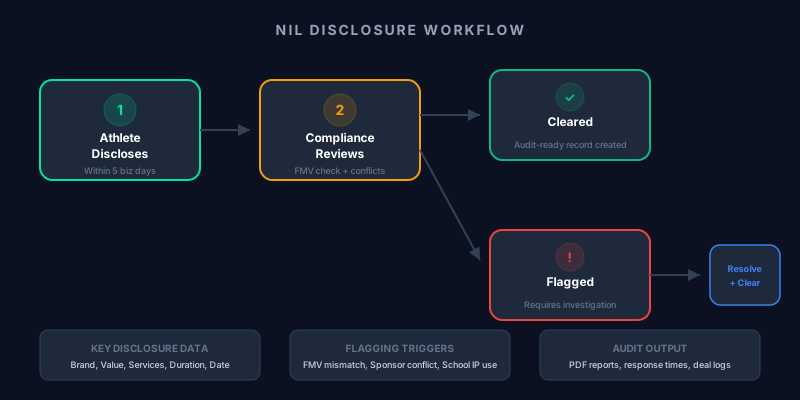
Flagging triggers:
- Compensation seems disproportionate to services (FMV concern)
- Brand conflicts with institutional sponsors
- Deal involves school marks or facilities
- Athlete is in a sport with conference-specific restrictions
- Deal timing conflicts with recruiting rules
3. State Law Awareness
Your compliance officer needs to know — at a glance — what your state requires. Not every state. Just yours.
Critical questions:
- What's our disclosure deadline?
- Do athletes need to notify us before or after signing?
- Are there specific reporting formats required?
- Does our conference have additional rules?
4. Audit-Ready Reporting
When your conference, the NCAA, or a state regulator asks to see your NIL activity, you need:
- Complete list of all disclosed deals by date range
- Status of each (reviewed, cleared, flagged)
- FMV verification documentation
- Response time metrics (time from disclosure to review)
- Any flagged deals and their resolution
5. Fair Market Value Documentation
FMV is the compliance tripwire. A deal that pays an athlete $50,000 for a single Instagram post from someone with 500 followers is a red flag. Your system should help identify outliers.
Factors that inform FMV:
- Athlete's social media following and engagement rate
- Comparable deals in the same sport and division
- Deliverables scope (one post vs. ongoing ambassadorship)
- Geographic market (national brand vs. local business)
- Athlete's competitive achievements
The Cost Problem
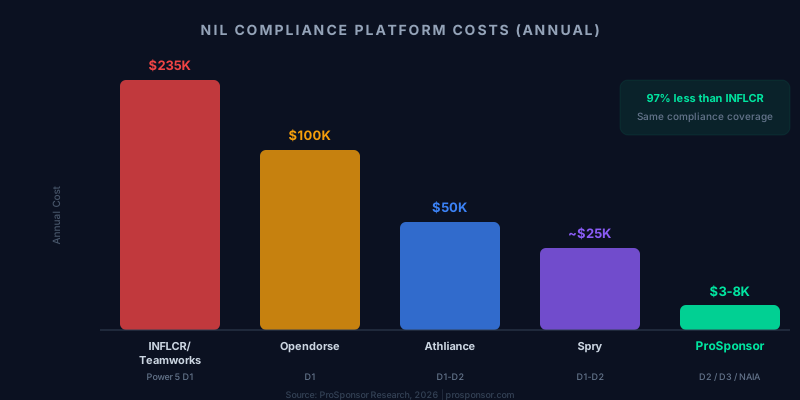
Enterprise NIL compliance platforms price for D1 budgets:
| Platform | Typical Annual Cost | Target |
|---|---|---|
| INFLCR/Teamworks | $50K–$235K | Power 5 D1 |
| Opendorse | $25K–$100K | D1 |
| Spry | Undisclosed (demo-based) | D1–D2 |
| Athliance | $15K–$50K | D1–D2 |
A D3 athletic department with a $500K total budget cannot allocate $25K+ for NIL compliance software. Yet the compliance obligations are the same.
Building a Sustainable Compliance Process
For Programs Under 200 Athletes
-
Designate a single point of contact. One person receives all disclosures. This is non-negotiable.
-
Set up a 48-hour SLA. Athletes submit; compliance acknowledges within 48 hours. This gives you buffer before the NCAA's 5-day requirement.
-
Create a simple intake form. Digital, mobile-friendly. Athletes won't fill out a 3-page PDF — they'll skip disclosure instead.
-
Establish FMV benchmarks. Document what typical deals look like at your level:
- Social media post: $50–$500 for <10K followers
- Appearance: $200–$2,000
- Ongoing ambassadorship: $1,000–$10,000/semester
- Autograph session: $100–$500
-
Review quarterly. Look at patterns. Are athletes disclosing? Are there gaps? Which sports have the most activity?
For Programs With 200–500 Athletes
Everything above, plus:
-
Sport-specific liaisons. Each head coach should remind athletes about disclosure obligations. Build it into preseason meetings.
-
Batch processing. Set review sessions twice weekly rather than ad-hoc. This prevents disclosure backlog.
-
Conference reporting. Know your conference's specific requirements and reporting formats. Prepare these reports monthly even if they're only required annually.
-
Education programming. One NIL education session per year isn't enough. Athletes need to understand contracts, taxes, and disclosure requirements before they sign, not after.
What Good Compliance Looks Like
A well-run NIL compliance program at any level has these characteristics:
- Zero surprise deals. If you're learning about an athlete's brand deal from social media, your process has failed.
- Fast turnaround. Disclosures reviewed within 48 hours, not weeks.
- Clear communication. Athletes know what to report, when, and how.
- Documented decisions. Every cleared and flagged deal has a paper trail.
- Proactive education. Athletes understand NIL rules before their first deal, not after a violation.
The Bottom Line
NIL compliance at the D2/D3/NAIA level doesn't require a $50K enterprise platform. It requires:
- A centralized place for disclosures
- A clear review workflow
- State law awareness
- Audit-ready records
- Reasonable pricing
The programs that get this right will protect their athletes' eligibility, satisfy regulators, and build trust with recruits who increasingly ask "how does your school handle NIL?"
ProSponsor's compliance tools are purpose-built for D2, D3, and NAIA programs — starting at $250/month. Schedule a demo to see how it works.